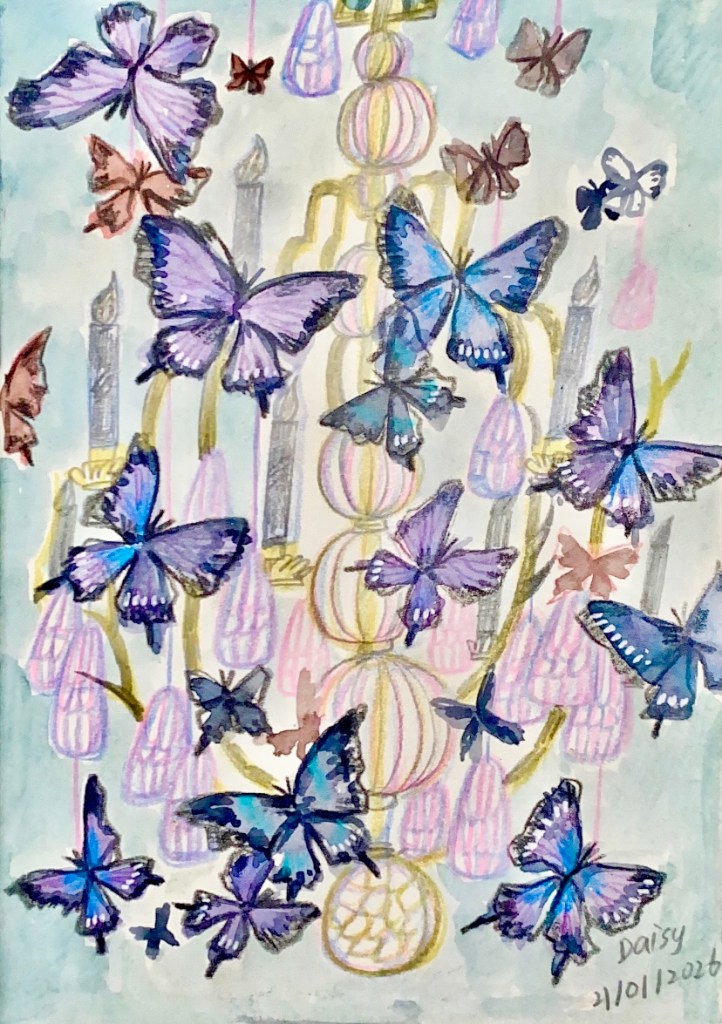
Today, I want to talk about a problem every artist has faced at some point: what should you do with the drawings you dislike—the ones that look “ugly,” messy, or like total failures? Should you throw them away? Or hide them in a drawer to collect dust?
I want to share three practical ways to deal with these drawings that seem worthless at first glance.
First, don’t rush to throw them out. They are far more valuable than you think.
We often demand perfection from ourselves. When a drawing turns out “bad,” our first reaction is to trash it. But in reality, these imperfect works are the most honest record of your progress. Do you think great artists never made terrible work? Van Gogh’s rough sketches, Picasso’s failed attempts—many of them survived, and today they are key to understanding their artistic growth. The drawings you dislike right now will one day become important evidence of your evolving style, color instincts, and line habits.
Second, use mixed media to transform the old piece into something new.
Paint over it, collage on top, layer new lines—try bold compositions and visual experiments on the old surface. This saves paper, of course, but more importantly, it gives you a pressure-free playground to explore. The traces underneath will become part of the painting’s memory, and with a relaxed mindset, you might create something surprisingly fresh.
Third, review your work—don’t just reject it.
Many people see a bad drawing and immediately think: “Maybe I have no talent.” But most of the time, what we lack is not talent—it’s the ability to evaluate ourselves. Ask yourself three simple questions:
- What actually worked in this piece? Composition? Color? Line quality?
- What part am I unhappy with? What went wrong?
- How can I improve next time, and what specific method will I use?
Once you shift from emotional judgment to analytical reflection, your art begins to grow in a real, meaningful way.
How we treat our “bad” drawings is often how we treat life.
Every day, we face choices, mistakes, and imperfect outcomes. Do we avoid them, erase them, and pretend they didn’t happen? Or do we pause, reflect, and understand why things went wrong? Each unsatisfying drawing is a mirror. It reminds us that imperfections and wrong turns are not failures—they are gateways to a clearer understanding of ourselves.
To summarize:
Keep your imperfect works—they reveal your growth.
Paint over them—use mixed media to experiment bravely.
Review them—break problems down into steps you can improve.
I’m Daisy, a storyteller who records and shares art. If you enjoy my content, feel free like, subscribe, and leave a comment. And share me: how do you deal with your unsatisfying drawings?

 Miss Daisy Drawing
Leave a comment