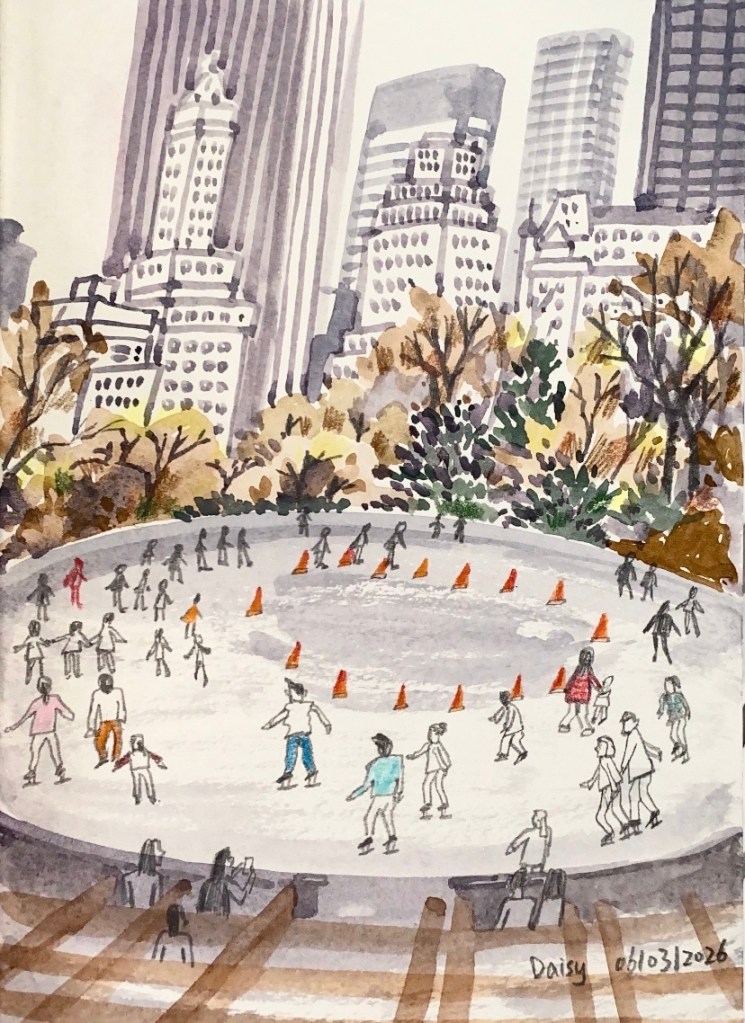
Today I want to talk about a question almost every art lover has asked at some point — and one many parents wonder about when their kids start learning art: Do we really need to use references? Do we actually need to draw from an object? If you have such questions, you need to keep reading. What I’m sharing comes from decades of drawing and learning, and I hope this video can bring some inspirations on this topic. Without further ado, let’s start it.
First, Drawing is a visual language — and every language needs input
Drawing is not just technique; it’s a form of visual expression, a visual language. And to learn any language, you need input.
To learn writing, you start with words, sentences, reading. To learn music, you start with notes, rhythm, melody. To learn drawing, you need to understand visual vocabulary and the objects you’re drawing.
Every time we draw something from observation, the coordination between “eye and hand” helps us understand the subject far more deeply than simply looking at it. Drawing is a tool that sharpens how we observe and understand the world.
Take trees, for example. Nature gives us thousands of tree varieties — different leaves, different trunks, different silhouettes. The more we observe and record, the richer our visual vocabulary becomes. The richer the vocabulary, the more alive our artwork becomes.
Good practice is not just about copying objects; it’s also about finding creative ways to express them. Many beginners get stuck on the question: “How can I make my drawing look realistic?” But in the context of contemporary art, that is actually the wrong goal.
The purpose of using references is to train your ability to see. The purpose of learning art is to express your own interpretation — even when everyone is looking at the same object or the same landscape. This process builds your aesthetic judgment and your ability to think independently.
Second. Using references is not “copying” — it’s intentional training
In a world where phone cameras are already hyper-realistic and AI can generate images instantly, the meaning of drawing is not to replicate what we see. What we really want is to express our feelings and ideas through visual language. Here are three ways to train that ability:
Number 1. Structure, perspective, and lighting matter, but don’t let them restrict you
Don’t be too harsh on yourself about accuracy. I often see drawings by kids or older hobbyists that aren’t technically precise, yet you can feel their pure love for art in every line. That raw sincerity carries emotional power that perfect realism sometimes lacks.
Number 2. Build your visual vocabulary through lots of quick sketches
Back to the tree example: Real trees come in endless forms, but in many artworks, trees are drawn with the same formula.
Instead of copying someone else’s tree, why not explore your own? Experiment with different lines, shapes, rhythms, and colors. When you can draw a “tree that belongs to you,” you’ve truly developed expressive ability.
Number 3. Think before you draw — the idea comes first
In traditional Chinese painting, there’s a guiding principle called “yi zai bi xian” — which means your intention should come before the brush. Whether you’re writing, drawing, or creating any kind of artwork, the idea is to fully form your vision before you put down the first stroke.
This principle applies to all mediums we use today — watercolor, oil, acrylic, and more. Whenever we face a subject or a scene that inspires us, we should pause and ask ourselves: Does this scene feel warm or lonely? Lively or quiet?
Once we understand what we truly want to express, elements like line, color, and composition naturally become our tools — not constraints. At that moment, we’re no longer just someone holding a brush; we’re more like conductors, guiding different instruments and voices to create a piece of art with real life in it.
Working this way means every painting carries our personal interpretation and thought process. And over time, this approach also helps us shape a style that’s uniquely our own.
Lastly . Abstraction requires foundations — abstract work without thought has no life
At this point you might be wondering: “There are so many abstract artworks today. Can’t I skip observational drawing and jump straight into abstraction?”
This question is especially common in children’s art education. Some parents want to “develop creativity,” for their children through drawing. So they avoid letting kids draw from objects. They are afraid that it will limit imagination. But this is actually the opposite of how creativity grows.
Abstraction and realism aren’t opposites. Abstraction is the refined essence of realism.
A strong abstract artwork comes from long-term training in: shape and structure, spatial understanding, rhythm and visual organization, color and form language.
It’s the artist’s sharp perception of the real world that gives abstraction intention, logic, and emotional resonance — not random color splashes.
If you skip the foundational observational stage, “abstract art” easily becomes random marks on paper. It may look free, but it’s hollow. It may look expressive, but lacks depth. It lacks visual logic, internal structure, and emotional meaning.
As many masters have shown us: Understand the world first. Then create your own. Realism is the foundation. Abstraction is the elevation. Realism helps you see. Abstraction helps you express.
So, I believe you’ve already have your own idea now. Do we need references when it comes to draw? Yes — but not for copying. References help us understand the world. But the ultimate purpose of drawing is emotional expression.
Our relationship with the reference object is not about “copying.” It’s about borrowing —borrowing nature, objects, visual language —to express what we truly want to communicate.
I’m Daisy, an artist who loves observing, drawing, and sharing.
If you enjoyed this passafe, feel free to like, subscribe, or leave a comment.
You’re also welcome to share your thoughts on art — I’d love to hear them.
 Miss Daisy Drawing
Leave a comment