Tag: education

  • How Does People-Pleasing Hold Back Your Artistic Growth?

    In my previous passages, I talked a lot about the connection between drawing, psychology, and neuroscience. Today, I want to continue that conversation and dive into another psychological pattern that quietly—but seriously—holds many artists back: people-pleasing.

    This is a struggle I dealt with for years. If you’re constantly dissatisfied with your work, switching styles all the time, or always chasing the kind of art you think others will like, this video may help you understand the true root of your frustration.

    In this passage, I’ll explain the link between people-pleasing and drawing through three lenses: your psychological mechanisms, your behavioral patterns, and the visual language that shows up in your artwork.

    What Exactly Is People-Pleasing?

    People-pleasing is basically a mindset where you put your own needs aside to avoid conflict, get approval, and keep the peace in your relationships. It usually comes from growing up with emotionally unstable parents, a strict or repressive home, or parents who only gave love and approval if you met certain conditions.

    Typical signs include: Ignoring your true feelings, Struggling to say no, Being extremely sensitive to other people’s reactions, Fear of conflict and overvaluing harmony, Relying on external validation to feel good. One compliment can make your whole day—while a single negative comment can crush you for a week.

    If we summarize people-pleasing in one sentence, it’s this:

    “I must meet other people’s expectations in order to be accepted.”

    In art, that becomes:

    “What will others think?” comes before “What do I want to express?” This mindset affects everything: your artistic motivation, aesthetic judgment, style development, and even your long-term confidence as a creator.

    So, How does People-Pleasing relate to Your Art

    1. Constantly switching styles and losing your authentic voice

    People-pleasers tend to deny their own choices. They study a style, mimic it, master it, then abandon it and move on to another one. Their technical skills grow fast, but their personal style never stabilizes.

    2. Choosing “safe” topics that will get praise

    To earn approval, they prefer drawing subjects that feel universally liked—pretty girls, cute pets, landscapes—while avoiding anything subjective, experimental, strange, or potentially misunderstood. They suppress their true artistic desires in exchange for being liked. This problem is especially common among women, simply because women are often taught—more than men—to be agreeable, well-behaved, and sensitive to others’ expectations.

    3. Perfectionism and harsh self-criticism

    People-pleasers tend to erase and redraw repeatedly, fear showing their work, and get deeply affected by likes and comments. They may create many pieces yet still feel “not good enough” and wonder if they “lack talent.”

    4. People-pleasing visual language

    People-pleasing doesn’t just affect your mind—it shows up in your visual decisions: Art made from a people-pleasing mindset often shows up directly in the visuals:

    the lines tend to be light, hesitant, or repeatedly traced;

    the composition usually places the subject small, pushed into a corner, avoiding the center, with an overall conservative layout.

    In terms of color, you’ll often see soft, low-saturation tones and a fear of using heavy colors like black or anything too bright or intense.

    All these visual traits are essentially reflections of the creator’s inner hesitation, uncertainty, and withdrawal.”

    Why People-Pleasing Can Be Really Damaging to Our Creativity?

    First, it drains our creativity and our willingness to take risks. When we’re constantly worried about how others see us or how they’ll judge our work, we stop expressing ourselves honestly. We play it safe. Our thinking becomes narrow, our imagination shrinks, and we slowly lose that sense of boldness and absurdity that makes art truly alive.

    Second, it suppresses the development of our own artistic style. A personal style is essentially a unique mix of our experiences, preferences, emotions, and the way we perceive the world. But people-pleasing creators focus so much on external approval that they ignore their internal voice. They keep adjusting themselves to fit other people’s expectations — which makes it impossible to settle into a style that’s genuinely their own.

    And third, people-pleasing makes us more prone to burnout. Every piece we create triggers self-doubt. We waste huge amounts of time trying different directions just to avoid making the “wrong” choice. Under the pressure of comparison and the fear of disappointing others, even something we once loved becomes harder to sustain.

    So with all that said, how do we change our people-pleasing tendencies? How do we shift from creating to please others to creating as a form of true self-expression?

    First, people-pleasing creativity is essentially externally driven — we’re constantly pulled around by other people’s feedback. To break out of that pattern, we have to reclaim our own agency and move from external motivation to internal motivation.

    I draw because I enjoy it. I draw to understand myself. I draw to explore new possibilities. I draw because it’s how I express who I am. Our creative purpose should always come from within, not from how others evaluate us.

    Second, when you’re making art, try not to obsessively correct every “wrong” line. Maybe one stroke is off, maybe a patch of color didn’t go as planned, maybe the subject doesn’t look perfectly accurate — but none of that really matters in the final piece. Sometimes the imperfect lines, the mistakes, even the “not-so-realistic” parts carry a kind of raw vitality. Many people actually love those imperfect attempts.

    What really matters is finding people who vibe with your work, instead of polishing yourself endlessly to make others like you.

    Self-doubt and perfectionism are the two major battles people-pleasers must overcome in the creative process.

    Finally, step boldly out of your comfort zone. Try subjects you’ve never drawn before, colors you’ve never used, compositions you’ve never attempted. Experiment with new mediums, make messy sketches, create things with no goal at all. These don’t need to become finished artworks, and you don’t have to show them to anyone. Just quietly observe: What did I learn from these experiments? Which attempts give power to my creative voice?

    The purpose of creating is self-exploration, self-expression, and self-growth —not to submit our work like an exam waiting for others to grade.

    People-pleasing only starts to fade when we understand and accept that it’s normal — and not a big deal — if others don’t like us. That’s when we truly reclaim our own sense of self.”

    I Hope you find this video helpful. If you enjoy my content, feel free to like, subscribe, and leave a comment. You’re also welcome to share your own thoughts on art in the comment section.
  • How to Learn Smarter So AI Can’t Replace You

    The Best Way to Learn in the Age of AI:
    Why Real Progress Comes from Doing, Not Reading

    I realized something important: Trying to gain ability through reading alone is secretly a way of avoiding the real work. It is a mental shortcut disguised as “self-improvement.” And it leads to zero results.

    Today I want to talk about a mindset shift that completely changed the way I learn, create, and even make money. And honestly, it might challenge some of your beliefs too.

    For a long time, I used to think that reading more books, watching more tutorials, and absorbing more information would naturally make me better. Better at drawing, better at learning languages, better at understanding the world.

    But here’s the truth I learned the hard way:

    Trying to gain ability through reading alone is actually a subtle form of “laziness.”

    It’s the hope that you can skip the hard parts—the frustration, the experimentation, the trial and error—and somehow jump straight to mastery.
    At its core, it’s a kind of “wanting results without doing the work.”

    And in the age of AI—when information is everywhere and skills can be automatedthe only learning method that truly keeps you ahead is not reading. It’s doing.

    Let me share how this plays out in my own journey across three areas: drawing, language learning, and making money.

    First. Drawing: You only improve when you create with intention

    I’ve been drawing for decades. And for a long time, I made the classic mistake:
    I thought I could improve just by reading art books or studying techniques.

    There’s nothing wrong with reading, but it should never be your primary path to progress. Because passive input without output doesn’t change your ability.

    Real improvement only happens when you draw with intention.

    For example, when I want to draw a cityscape, I don’t just “look” at it. I think:

    How do I draw skyscraper?
    How do I show the movement of crowds?
    How do I make the lights feel alive?

    When you create with a purpose, your input becomes meaningful. The world becomes specific. And your drawings carry your own thinking—not just technical labor.

    Second. Language learning: You will never sound natural by memorizing vocabulary or studying textbook

    I upload my drawing videos in both English and native language. The English version really forced me to grow—because I had to use the language, not just study it.

    When I translate my scripts, I naturally learn the exact vocabulary I need:
    words like unpredictability, figurative, ornamentation. Not random textbook words—But the actual words that matter to my message.

    And when I record voiceovers, I have no choice but to try, fail, and try again.
    My early recordings were stiff and flat. I even tested AI voiceovers, and while they sounded perfect, but they felt lifeless and have nothing to do with me.

    So I kept practicing. And slowly, my rhythm, pronunciation, and flow improved—not to native level, but enough to communicate clearly and connect with viewers.

    None of this came from reading English books. It came from using the language, publicly, imperfectly, repeatedly.

    Third. Making money: Income is a reward for taking deliberate action.

    For years, I believed that “reading more books” would help me earn more.
    I once forced myself to finish a book every two days on management, investing, finance—you name it.

    Looking back… it was naive. Books don’t make you money. Products, actions, experiments, and real-world feedback do.

    You can apply the same logic here: Just as drawing improves through purposeful creation, and language improves through speaking…earning money improves through building things, testing ideas, and understanding the market.

    Creating videos is, in itself, building a product. Some videos perform well, some fail. Why? Only action reveals the answer.

    If you don’t act, reflect, and act again, you’re not improving—you’re just repeating the same day 1,000 times. Money is simply the reward for intentional action.

    So what’s the real lesson?

    I finally realized something important: Trying to gain ability through reading alone is secretly a way of avoiding the real work. It is a mental shortcut disguised as “self-improvement.” And it leads to zero results.

    In the age of AI, reading is cheap. But doing—thinking, creating, trying, failing, iterating—is what actually builds skill and keeps you ahead.

    I’m Daisy, a storyteller who records and shares art. If you enjoy this kind of content, feel free to like, subscribe, or leave a comment. And if you’re navigating your own challenges in learning or creating, share them below—I’d love to hear your story.

  • Lost Your Passion for Drawing? 

    A lot of people believe that the joy of drawing comes from “being good at it.” But the truth is the opposite. The more we chase perfection, the more we try to prove ourselves, the heavier drawing becomes. We compare ourselves to professional artists and illustrators, and the moment our work looks “off” or “not good enough,” we start questioning everything—our talent, our potential, even whether we should keep drawing at all.

    This mindset shows up not only in art, but also whenever we try something new. So today, I want to share how you can truly rediscover the joy of drawing—how to start anything with zero pressure and learn to enjoy the process again.

    First, you need to allow yourself to “draw badly.” Allow yourself to make mistakes. It sounds simple, but for most of us, it’s incredibly difficult. Especially in our culture, where school, family, and society don’t really give us room to fail. Many of us grow up walking a path that seems to demand “the correct answer” in everything we do, but that path is often filled with pressure and anxiety.

    But drawing isn’t just a professional skill. It’s also a game, a visual exploration, a way to enter a flow state, and even a form of therapy. That’s why you need to “demystify” drawing—or anything else you want to pursue. You’re not facing a monster. You’re facing a gentle little rabbit.

    Second, put aside the grand goal of finishing a large, polished, complex artwork. Start with the smallest possible action. Sketch what’s around you—draw a tree, a cup, a wash of watercolor, or even just a few lines. None of these need to become finished pieces. These tiny practices remind you that sometimes starting matters more than finishing.

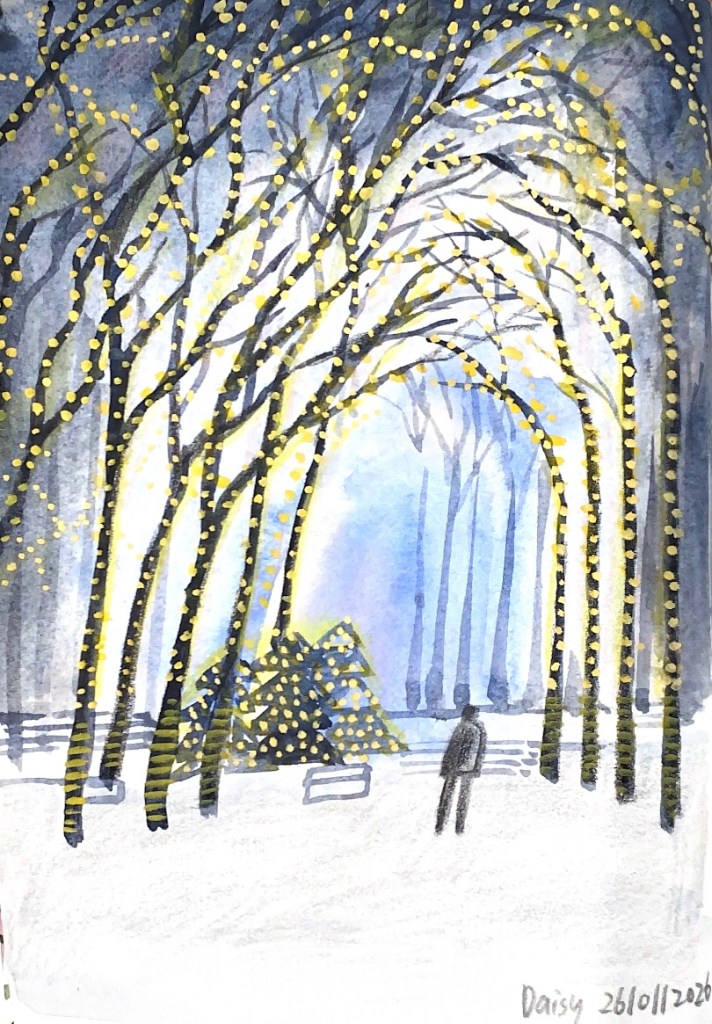
    Third, treat drawing like an adventure—a treasure hunt. Maybe you’ve had phases when you drew mindlessly, constantly producing work but never improving. That’s because you weren’t exploring. Exploration means asking: Which colors feel most harmonious together? How do you paint the glow light in the night time? How do different leaves behave on different trees? What colors define autumn leaves? How do you paint winter snow? Does every object has to be its original color?

    Exploration comes with failures, but also surprises. And trust me—you’ll be amazed and proud of the unique effects you discover on your own.

    And isn’t life itself an adventure as well? Give yourself more patience. Anything you love is worth exploring again and again.

    When you let go of judgment, comparison, and the pressure to “be good,” you’ll realize something: the joy of drawing never disappeared. Beyond the roles and responsibilities that society and family place on us, life still holds countless sources of meaning and joy waiting for us to unlock. They were simply hidden behind all the pressure.

    What you need now is just a little space for yourself each day—enough for drawing to illuminate your life again.

    If you enjoy my content, feel free to like, subscribe, and leave a comment. You’re also welcome to share your own thoughts on art in the comment section.
    I’m Daisy, a storyteller who records and shares art. I hope my words and drawings inspire your own creative journey.

  • Learn Art Without School: A New Perspective

    You don’t need to attend an art school to learn art.

    Screenshot

    Today I want to share a viewpoint that goes completely against the usual expectations: you don’t need to go to an art school to learn art, and you don’t need to go to university to learn how to make money. In this era, “learning” and “school” are two entirely different things.

    Learning is something you do for yourself. You learn what you’re genuinely interested in, and what will actually benefit you.

    School, on the other hand, is a system. Beyond teaching students, it also exists to provide employment and maintain social stability. Take content creation as an example: for most people today, it’s one of the most accessible and practical career paths. But do you really need a university degree in media studies to become a content creator? When it comes to making content, whose lessons are more valuable—top creators whose videos have millions of views , or university professors? People who benefit from staying inside the system will never point this out.

    A lot of people still treat ‘school’ as if it were the whole definition of learning—as if you can only study art by getting into an art academy, or only become employable by earning a university degree. But that mindset is completely out of touch with how the world works today.

    First, the internet now offers more resources than any other time in history. You can view high-quality images of original artworks, listen to open courses from leaders across different industries, follow your favorite artists, or join online communities where people motivate each other and stay accountable. Learning—whether it’s art or most fields that don’t require strict technical certification, such as languages or management—does not need to happen inside a traditional institution.

    Second, this era demands that we understand ourselves more than ever. You need to use every tool around you—reading, writing, and the vast information available online—to discover your strengths and direction. Education today is shifting toward “self-education.” We all have to move from being passively guided to being self-driven, from chasing credentials to building real capability.

    Don’t let the belief that “you must go to school to gain a skill” limit you. As long as you keep practicing, keep learning, and keep creating, you can grow anywhere—and it’s never too late to start.

    Stop tying your growth to school, and stop letting others define your future. The right to learn is in your own hands, and the only person who can truly determine how far you go is you.