Tag: painting

  • Will AI Replace Painting? 

    Make sure you watch this content to the end — it might completely change the way you see AI, and it might even reveal a new career path for you.

    Recently, I watched a talk where the well-known contemporary artist Xu Bing discussed the impact of AI on painting. After watching it, I was genuinely excited — and honestly a little honored — to realize that many of my thoughts align closely with his.

    So today, I want to take you deeper into this question: Will AI replace painting?

    My answer is: Yes… and No.

    Let’s start with Yes.

    If we define painting simply as “image generation,” then AI can absolutely do that — faster, cheaper, with more styles, and with endless variation.

    When painting is reduced to pure “visual production,” AI is incomparable. It can generate a stunning image in just a few seconds.

    In this sense, AI will replace forms of painting that rely mainly on technical skill and execution. Commercial illustration, game concept art, environment design, poster drafts, character development — AI is already taking over most of the basic production work.

    And in fact, that was one of the original intentions behind AI: to free humans from repetitive labor.

    Now let’s talk about the No.

    If we understand painting as a form of expression, a way of thinking, a process of interacting with the world — then AI can never replace human beings.

    First, emotionally.

    Painting, music, dance — these art forms are fundamental to what separates humans from animals. They come from our need to explore emotion, experience, and meaning.

    We are born wanting to express ourselves. Painting is one of the ways we externalize our inner world, and as long as humans exist, this impulse will exist.

    Why do we cry, or feel moved, or feel awe in front of certain artworks?
    Because in the image, in the brushstrokes, in the texture of the pigment, we can sense the artist’s living experience — their emotions, insights, confusion, curiosity, and exploration.

    This is something AI cannot achieve, even at its peak. Work with a human heartbeat, human perspective, and human worldview… still belongs only to humans.

    Second, initiative

    Yes, AI can generate the visuals we need for commercial work — the illustrations and concepts I mentioned earlier. But a human still has to decide the scene, the character traits, the aesthetic direction, the message, the intention.

    At least for now, AI needs human guidance. Humans remain the creators.

    And what we’re experiencing today is no different from the major technological revolutions in history.Every revolution reshapes labor and industry. Old roles disappear, and new ones emerge.

    In the First Industrial Revolution, handcraft labor declined, and factory workers and railway builders emerged.

    In the Second, horse-powered transport disappeared, replaced by electrical engineers and communication workers.

    In the Third, traditional typesetting and editing declined, replaced by programmers, UI/UX designers, and digital roles.

    And in the Fourth — the AI revolution we are living through — roles like copywriters, basic image producers, and some education jobs are shrinking; while AI trainers, independent “super creators,” and digital-asset professions are emerging.

    If you look closely at each revolution, you’ll notice a pattern:

    Human value keeps shifting upward — from physical labor to skill, to intellectual work, and now to pure creativity and imagination.

    This is why we need to shift our mindset.

    Seeing AI as a threat to human survival only leads to resistance — and that means rejecting the next wave of progress.

    Today’s AI isn’t here to destroy us. It’s a tool that pushes each of us to become more imaginative, more creative, and more initiative.

    And these abilities thrive in artistic practices — painting, music, dance, writing, and every form of creation. So painting will never disappear as long as human exist. 

    If you enjoy my content, feel free to like, subscribe, and comment. You’re also welcome to share your own thoughts and reflections on art in the comments.

    I’m Daisy, a storyteller who records and shares art. I hope my words and drawings inspire your own creative journey.
  • The Most Important Skill for Today’s Artists Isn’t Realism II

    Building on the previous content The Most Important Skill for Today’s Artists Isn’t Realism  I – last time we looked at the limitations of hyper-realistic painting from the perspective of art history and the artist’s creative process.

    In this episode, I want to shift to the art market and the audience, and explore why, today, the pursuit of extreme realism isn’t just outdated, but may actually run against the direction of our time.

    Let’s start with a simple question:

    If you wanted to hang a painting in your home, would you choose a highly realistic portrait or a traditional landscape Painting?

    I believe most young people wouldn’t choose either.

    And the reason is pretty simple.

    No matter what your interior design style is, realistic paintings and modern home aesthetics belong to two completely different visual languages. Put them together and there’s a subtle, indescribable sense of mismatch.

    That’s why many people are more inclined to choose an abstract or geometric piece—even if they can’t understand it at all—as home décor.

    Modern viewers actually gravitate toward abstract, geometric, and ambiguous works.

    Even when the content is unclear, the artwork fits the space. It fits the mood.
    Its functional role matters more than its storytelling role.

    But why is that?

    It’s because our entire visual environment—architecture, furniture, product design—has been deeply influenced by the Bauhaus design movement of early 20th-century Germany.

    Bauhaus emphasized one core principle: “form follows function.”
    Meaning: function comes first, form and decoration come second.

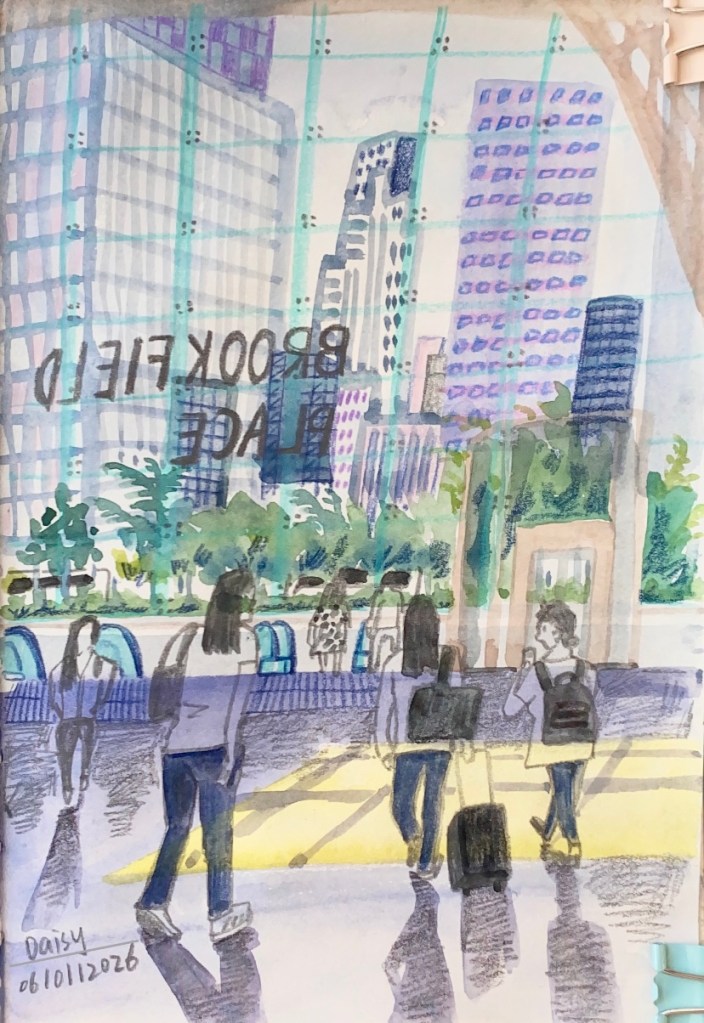
    The high-rise buildings we see everywhere today—dominated by straight lines and almost zero ornamentation—are direct results of this philosophy.

    To accommodate more people and improve spatial efficiency, simplicity became the mainstream aesthetic.

    And Scandinavian furniture, IKEA’s clean lines, all those minimalist, functional designs—they are everyday extensions of Bauhaus thinking.

    Once you understand this, it becomes clear why today’s art market favors decorative, highly stylized works over hyper-realistic figurative paintings.

    Of course, every style has its own audience. This isn’t a value judgment, but a trend analysis: what kinds of works are more likely to be chosen and collected by the general public.

    So what do today’s art audience actually favor ?

    In an era dominated by short-form videos, endless visual feeds, and decreasing attention spans, what grabs people first is always form, not content.

    Or, you could say that content itself becomes part of the form.

    In today’s visual culture, the two are almost inseparable.

    In the next content, I’ll talk about why AI will not truly replace painting.

    I’m Daisy, a storyteller who loves and shares art. I hope my words and drawings inspire your own creative journey .

  • The Most Important Skill for Today’s Artists Isn’t Realism I

    Today, I want to share some thoughts on painting and creative practice.

    In this era, the most Important skill for today’s Artists isn’t Realism. obsessing over extreme realism is not only outdated, but it also leads you down a path that runs counter to where art is actually headed.

    If we look at the history of painting—specifically the history of Western art—before the invention of the camera, painting existed to reproduce mythology, Christianity, and the lives of royalty and the bourgeoisie. The invention of photography destroyed the foundation of “representation” in painting, but at the same time, it accelerated the evolution of artistic form. From Impressionism to Fauvism, Constructivism, Surrealism, Abstract Expressionism, and Pop Art, twentieth-century art took on countless forms—none of which were concerned with how closely a painting resembled its subject.

    Traditional drawing education—especially pencil sketching—originates from Western realist oil-painting training. Techniques like structural analysis and perspective were once fundamental, but within today’s artistic context and visual vocabulary, they are no longer universal.

    Painting itself is a language: new vocabulary emerges with each era, and outdated vocabulary naturally fades away.

    People often point to the contemporary hyperrealist Leng Jun as proof that realism is still valued in the art market. But this example is not representative—just as you cannot use Ke Jie to generalize the entire world of Go, especially when comparing him to AlphaGo. There is only one Leng Jun, just as there is only one Ke Jie.

    Meanwhile, AI can now generate images that are more realistic, faster, and more “perfect” than anything we can create by hand—just as photography once threatened traditional painting. Competing with AI on realism is meaningless.

    Have you ever wondered why children love animation, and why many adults still do? Beyond storytelling, animation offers visual distortion, reinvention, and imagination—an escape from reality. Art pulls us out of the real world, and that is precisely what makes it intoxicating.

    That is why the true competitive edge of contemporary painting is no longer the ability to replicate reality, but the ability to create what reality does not contain. Modern artists need the ability to build dreams for their audiences.

    After all, an artist’s emotions, stories, and way of seeing the world are things AI cannot replicate. So the next time you hesitate and ask yourself, “Should I make this look more realistic?” maybe the better question is: “Is there even one stroke in this painting that only I could have created?”

    Painting will never become obsolete. Only the artists who remain trapped in the past will.

    In the content, I’ll keep discuss this topic from the perspective of the art market and today’s audiences.

    If you enjoy my content, feel free to like, subscribe, and comment. You’re also welcome to share your own thoughts and reflections on art in the comments. I’ll see you soon.

  • How to Start Drawing When You Don’t Know What to Draw

    “Not knowing what to draw” is a problem we often face when painting. For example, you really want to draw, your brush is in your hand, but your mind feels like it’s on pause. Or you search online for references, see a composition that’s too complex, colors that are confusing, and slowly you have no idea where to start.

    What’s really stopping us from putting brush to paper is a subtle worry. It’s like when we want to do something, but before even starting, we imagine all the things that could go wrong. Fear is the worst enemy—fear is our own greatest obstacle.

    Creating is a process of facing the unknown, and it shatters our perfectionism. Especially when we’re just starting out with drawing—or doing anything—imperfection is actually the norm.

    So how do we overcome the “I don’t know what to draw” problem?

    First, change your goal from “making a perfect painting” to “just draw something.”
    You can draw the cup on your desk, the clouds outside your window, your dog doing something silly at home, or even random lines, shapes, or doodles. Just get your hand moving, and let your subconscious and momentum do the rest.

    Second, treat drawing as “recording,” not “producing a masterpiece.”


    Break the big goal of a “finished artwork” into small daily steps. Use drawing like a diary—record the light you see, your mood, the story you want to tell, or flashes of inspiration that suddenly come to you in a sketchbook.

    Third, allow yourself to be imperfect and make mistakes.


    If you can’t draw something, it’s often because you’re trying to get it right in one go—but very few things in this world happen perfectly on the first try. Inspiration isn’t some magical gift; it’s the side effect of accumulation, thinking, and habit. Behind every beautiful, polished artwork, there are often hundreds or thousands of failed attempts.

    So next time you don’t know what to draw, try telling yourself:


    “It’s okay. Just draw something.”


    Even if it turns out wrong or messy, the worst that happens is you waste a sheet of paper.