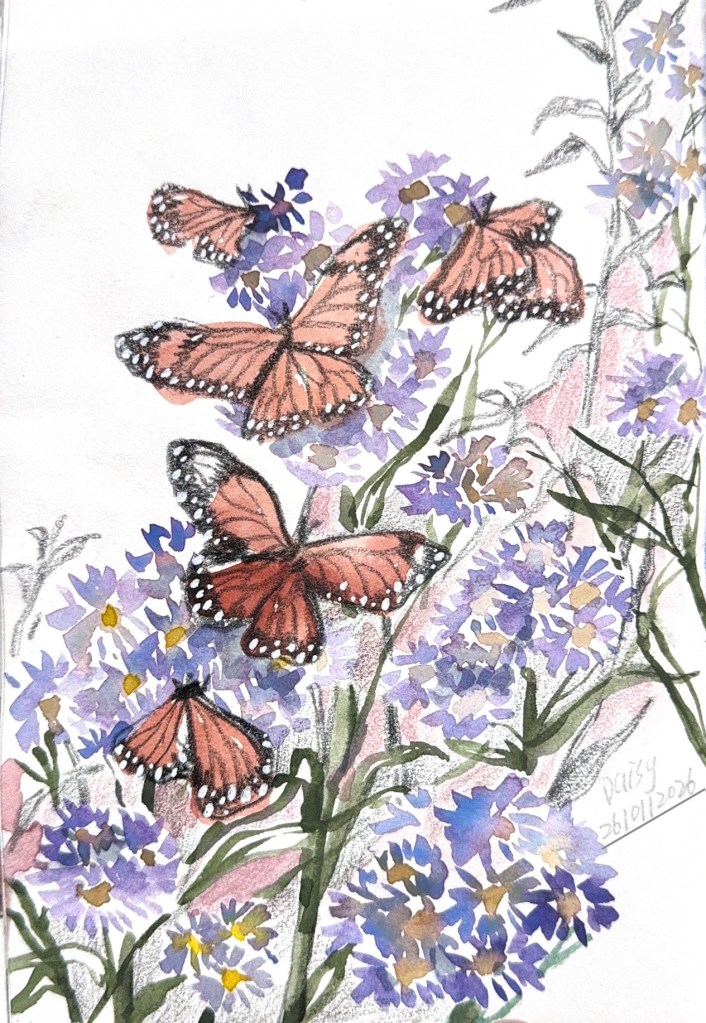
Today, I want to share a letter I wrote to one of my 8-year-old students. This little girl absolutely loves my art classes. She often tells me that I’m her “No. 1 Art Teacher.”
Every time she says that, it makes me so happy. Because I genuinely want to help her learn and grow through art. But as I spent more time teaching her, I noticed that some of the ways she approached drawing had been shaped by a very traditional approach to art education.
She was constantly looking for reference images while she was drawing. If she thought something looked “wrong,” her first instinct was to erase it. After drawing for a while, she would start saying:“My drawing isn’t good.” She also really liked using a ruler to make her lines perfectly straight. One day in class, I honestly couldn’t just sit and watch anymore. She was spending more than half of the lesson erasing her drawing, correcting it, and telling herself that it wasn’t good enough.
So I asked her: “Before you came to my class, did you learn drawing from another art teacher?” She told me that she had started learning to draw when she was four. Back then, her teacher would give her a finished picture and ask her to copy it. And whenever her lines weren’t straight enough, she was told to use a ruler. At that moment, I felt like I had finally found the answer. I began to understand why an eight-year-old child could feel so afraid of “getting it wrong” when faced with a blank piece of paper.
She had learned something very early on: There is a right answer in drawing. If it doesn’t look like the reference, it’s wrong. If the line isn’t straight, it’s wrong. If the artwork isn’t beautiful enough, it’s not good enough. You could actually feel the tension and self-doubt in the way she drew.
So I decided to write her a letter.
“Dear Liz,
Thank you for always telling me that I’m your “No. 1 Art Teacher.”
You really make my heart melt. So, as a little gift in return, I want to share a secret about art with you.
You know, in everyday life, we do have to follow rules most of the time. We need to write clearly so that other people can read our handwriting. We need to play the right notes on the piano so that the music sounds the way it is supposed to.
But when it comes to art, we don’t always have to follow all the rules.
In my class, we learn a lot about art. Much of what we learn comes from things that artists have discovered through years of observing, experimenting, and creating. We can learn from these ideas, and we can use them. But that doesn’t mean we always have to follow them exactly. And it certainly doesn’t mean we have to copy someone else’s artwork.
I want you to feel free in my classroom. Even if you want to get a little bit crazy, that’s completely okay. Don’t always worry about making your drawing beautiful or perfect.
Instead, try asking yourself: How do I feel when I want to draw this? How can I use lines and colours to express that feeling?
Maybe your lines aren’t straight. Maybe your colours look nothing like the colours you see in real life. Maybe the final drawing doesn’t look “beautiful” in the way other people might expect. And that’s completely okay. Your artwork is already special because it comes from your own ideas, your own way of seeing, and your own way of drawing.
Always remember: When you try to draw something exactly the way it looks in real life, you may only have one path to follow. But when you free yourself from those rules, you suddenly discover that there are millions of different paths you can take.
And that is what makes creativity so exciting. And life works the same way.
Love,
Miss Daisy
Since she also plays the piano, I designed a special lesson that combined music and drawing.
We listened to three classical pieces inspired by moonlight: Debussy’s Clair de Lune, and the second and third movements of Beethoven’s Moonlight Sonata.
All three pieces evoke the moonlight, but they express very different emotions. One feels peaceful and serene, while another feels melancholic, and another carries a sense of anger and intensity.
So we tried to translate these three pieces of classical music into a visual language of colour and line.
Of course, one lesson isn’t enough to completely change the deeply ingrained habits she has developed through her previous art education.
But I hope that, through these small moments of sharing and experiencing art, she will gradually develop a different understanding of drawing and art.
This experience also made me realise something very deeply:
The impact of misguided teaching can be much greater than we realise.
It can teach people to live within limitations for years, believing that those limitations are the truth, and prevent them from discovering the freedom to create in their own way.
 Miss Daisy Drawing
Leave a comment